40%
of US dollars in circulation were created in recent years through quantitative easing, but this is only part of the inflation story.
Financial discourse frequently discusses the inevitable impact of central bank monetary policy and how expanded money supply may contribute to economic instability. However, many ignore another inflationary source that compounds the potential impacts: cryptocurrency. This represents a significant inflationary threat to fundamental economic stability that remains largely unexamined.
How Inflation Actually Works
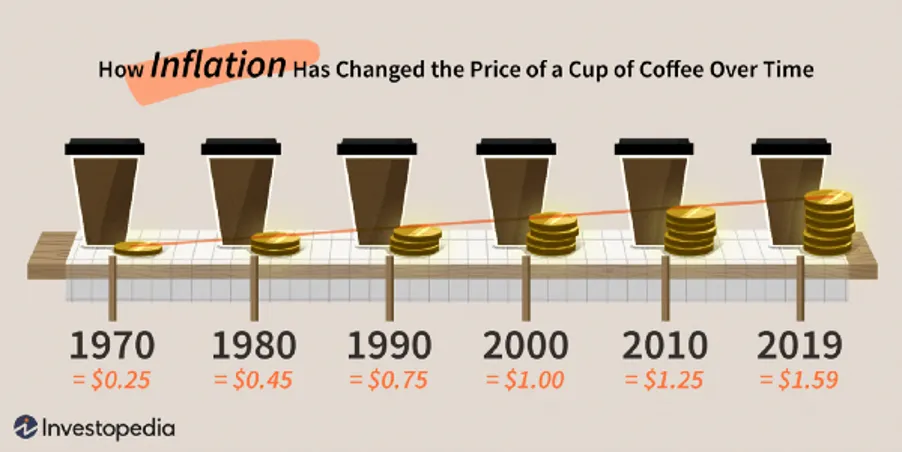
How inflation affects the real cost of consumer goods over time
Currency circulation causes inflation when the supply of cash or equivalent increases artificially, exceeding the value creation provided in the economy. When demand at the same cost level rises while supply remains constant, the supply side responds with price increases. This creates an exponentially proportional cycle where purchasing power parity (PPP) decreases during periods of economic shock.
Controlled inflation at low levels is generally beneficial. It incentivizes consumption and investment because saving money in a bank account creates a loss of value over time. But uncontrolled inflation, especially when wages remain stagnant, squeezes purchasing power and causes an economic cycle of declined consumption and relatively unaffordable pricing.
The Cryptocurrency Inflation Mechanism
In current economics, money holds a perceived value at which the general concept of barter can operate efficiently. Cryptocurrency does not have a 1:1 exchange with fiat currency to set value, yet it is created in a manner similar to how fiat currency is "printed" or entered into the system as new circulation.
The computational power required to create new cryptocurrency is always at a significantly lower cost than the exchange rate of currencies like Bitcoin. This implies that perceived value is being created from essentially nothing in the form of a currency, which is functionally equivalent to digitally printing fiat currency.
The Scale of Value Creation
Cryptocurrency market capitalization has grown by trillions of dollars in value. The ratio of real value (computational cost, energy expenditure) to perceived value (market exchange rate) is difficult to articulate, but the gap is substantial. This represents a massive injection of "perceived value" into the global monetary system.
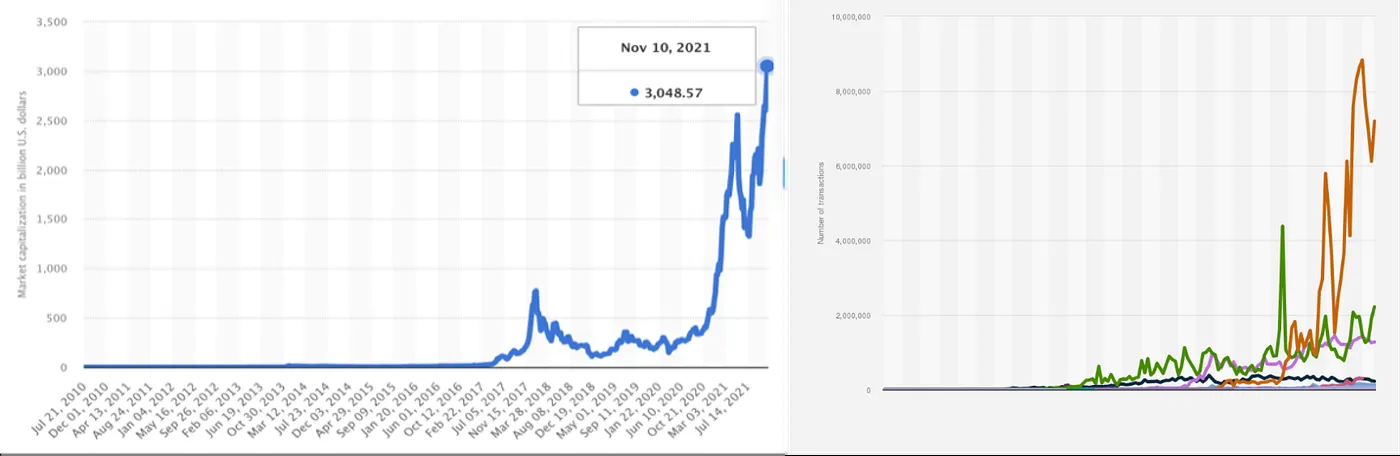
Cryptocurrency market cap and transaction volume growth
From Speculation to Real Economy Impact
A pure speculative bubble with perceived value and no circulation of supply-side facilitation is concerning. What is more concerning is when cryptocurrencies are actively used for purchasing goods, stocks, and services.
The integration of cryptocurrency as a medium of exchange and its usage in day-to-day transactions has grown exponentially. When perceived value at face exchange rates is used to buy goods and services, and this is mixed with massive new currency circulation being introduced, the demand capacity for goods increases far beyond the actual supply of goods in circulation.
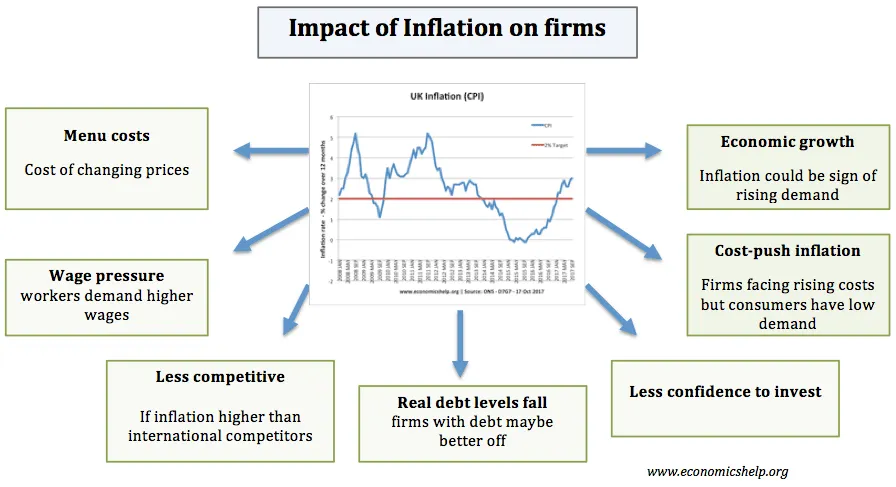
The multi-dimensional impact of inflation on firms and the broader economy
The Compounding Risk Factors
Consider the broader economic context:
- Median wages remain relatively stagnant
- Unemployment pressures persist in various sectors
- Asset prices (housing, equities) continue rising
- Default rates fluctuate with economic conditions
- Stock markets often rise despite underlying economic stress
These indicators suggest market dynamics that may be disconnected from fundamental economic value creation. Adding an uncontrolled and unaccounted source of currency-equivalent value creation compounds the systemic risk.
The Regulatory Gap
This additional layer of inflationary risk is currently not being considered by governments or central banks in their economic modelling. Traditional inflation metrics focus on fiat currency supply and velocity, but do not adequately account for the introduction of perceived value through decentralized currency creation.
The concept of decentralized currency has merits, particularly in terms of transparency, especially given the scale of central bank monetary expansion. However, the deregulated nature by which cryptocurrency operates creates unseen risk to the interconnected global supply chain.
The Core Question
What happens when perceived value, used at face value based on traded exchange rates to buy goods and services, is mixed with massive currency circulation being introduced? The demand capacity for goods increases exponentially more than the actual supply of goods in circulation. This is the textbook definition of inflationary pressure, but from a source outside traditional economic measurement.
Implications for Economic Modelling
Economists, bankers, and financial experts should consider building accurate economic models that understand the true scope of this phenomenon. The interaction between traditional monetary policy (fiat currency expansion) and decentralized value creation (cryptocurrency mining and appreciation) creates an "invisible tax" on purchasing power that current models do not capture.
This is not an argument against cryptocurrency as a concept. The transparency and decentralization principles have value. It is an argument for serious analysis of the macroeconomic implications of value creation that operates outside traditional regulatory frameworks and economic measurement systems.
First Principles Analysis
- →Value creation without corresponding goods production is inflationary
- →Cryptocurrency mining cost is far below market exchange value
- →When crypto is used for real purchases, perceived value enters real economy
- →Current economic models do not account for this value injection
- →The risk compounds with traditional monetary expansion